Construction Variations for UK Builders: How to Price Them, Get Them Signed and Get Paid
William Charlesworth-Jones10 min read
Quick Answer
A variation is any change to the work in the contract: something added, something taken out (an omission), or a change to the specification, such as a different tile or a door moved. Price it the way you priced the job: labour, materials, plant, then overheads and profit, plus any extra time it adds to the programme. Put it in writing and get the client’s signature on the price before the work starts, because a variation agreed by word on site is the one most likely to be argued down or forgotten at the final account. Once signed, it adds to (or, for an omission, comes off) the contract sum, and you claim it in your next valuation like any other line.
The client walks the site on a Saturday, asks for two more sockets and the door moved along a bit, and everyone nods. Six months later the final account is an argument about what was agreed and for how much. This guide is part of our guide to construction cost management, and it is about getting that money in without the argument.
What Counts as a Variation in Construction?
A variation is a change to what the contract says you will build. If the drawings, specification or schedule of works describe one thing and the client (or their architect) asks for another, it is a variation. There are three kinds:
Additions. Extra work that was not in the price: another rooflight, more sockets, an extra course of blocks to raise a wall.
Omissions. Work taken out: “leave out the fireplace”, “we will do the decorating ourselves”.
Changes to specification or method. The same item, done differently: porcelain instead of ceramic tiles, a door moved 600mm, a different brick, working weekends to suit the client.
The test is simple: does the request change what you are obliged to deliver? If yes, it is a variation, however small. Putting right your own defective work is not one.
Why Do Unrecorded Variations Cost Builders So Much?
There is no reliable national figure for the margin UK builders lose to unpriced extras, but ask any QS where a job’s margin went and variations come up quickly. The reasons are plain:
The price is set after the work, by the person paying. Once the sockets are in, the client has no reason to agree a fair rate. A variation priced before it starts is a quote; priced afterwards, it is a negotiation you have already lost half of.
Memory fades on both sides. The client remembers “a couple of sockets”. You remember a day of chasing out, making good and a second visit from the plasterer.
The small ones never get written down. Ten £150 changes with no paperwork add up to a rooflight’s worth of money.
Time is the forgotten cost. A change that adds two days to the programme also adds two days of site set-up, supervision and scaffold, and none of it shows on the materials invoice.
The fix: price it, write it down, get it signed, then do it.
What Does a JCT Contract Say About Variations?
Most JCT forms give the client the right to vary the work and give you the right to be paid for it. The forms a small or mid-sized UK builder is most likely to meet are:
The JCT Minor Works Building Contract (MW 2024), for smaller jobs with a lump sum price, drawings or a specification, and monthly interim payments. See the JCT product page.
The JCT Building Contract for a Home Owner/Occupier (HO/B 2021), for domestic work where the homeowner has not appointed a consultant, with a companion form (HO/C) for when they have. See the JCT HO/B page.
Construction Management’s note on Minor Works 2024 says the form encourages the parties to agree a price before the work goes ahead, that the contract’s own rates may be the basis for valuing it, and that otherwise a fair and reasonable valuation supported by evidence is needed, covering labour, materials, plant, subcontractors, overheads and profit. It also advises confirming any verbal request in writing quickly, and considering whether an extension of time is needed (Construction Management, checked 4 November 2026).
Many domestic jobs run on a builder’s own quote and terms instead. Your terms should still say that changes are priced and agreed in writing before they are done. For a large or disputed variation, read the clause in your contract and take advice.
How Do You Price a Variation?
Price a variation the way you priced the original job, and use the rates in your quote where they apply. If your estimate had a rate for second fix sockets, use it. Where it does not, build the price up:
Labour. Every trade, at your cost rate, including making good and return visits.
Materials. At cost, with delivery and waste.
Plant and access. Scaffold, a tower, hired tools, an extra skip.
Subcontractors. Their quote for the extra.
Overheads and profit. At least the job’s own markup. Extra work is disruption.
Time. Any days added to the programme, with the time-related costs (supervision, hire) for those days.
VAT. At the rate for your work, not what you bought in.
A worked example. The client asks for a rooflight in the flat roof of a single storey extension that has already been felted:
Item
Build-up
Cost
Carpenter: trim the opening and kerb
1.5 days at £240
£360.00
Roofer: cut in and re-felt around the kerb
1 day at £220
£220.00
Plasterer: line the reveal
0.5 day at £220
£110.00
Rooflight unit
Merchant price
£780.00
Timber, fixings, felt and trims
Merchant price
£145.00
Tower scaffold
1 week hire
£150.00
Waste and skip share
Allowance
£40.00
Cost
£1,805.00
Overheads and profit at 15%
£270.75
Price to the client before VAT
£2,075.75
VAT at 20%
£415.15
Total
£2,490.90
Time
Adds 2 working days to the programme
Rounding the price to £2,100 is fine. What matters is that the build-up exists, so you can show it if the client asks. For costing your own people, see our guide to labour cost per job.
BuildersAI solution:
In BuildersAI a variation (called a change order) is priced from the cost plus your markup, sent to the client by email, and signed on their phone with no account, before the work starts. Flat pricing from £149 a month, 14-day free trial.
It needs to be clear enough that a stranger could read it in a year and know what was agreed:
A number. VO-001, VO-002 or CO-001, so each one can be referred to on invoices and in the final account.
The job and the client.
What the change is, in plain words, and what it involves.
Why: client request, design change, something found on opening up.
The price before VAT, the VAT and the total. For an omission, the credit, shown as a minus.
The effect on time, if any.
The client’s signature, name and date.
A text saying “go ahead” is better than nothing, but it rarely carries the price, and it lives on one person’s phone.
How Do Omissions and Credits Work?
An omission takes work out of the contract, so the contract sum goes down. The starting point for the credit is what you priced that work at in your quote, not what it would have cost you. Two things can reduce it:
Costs already spent. Materials ordered and not returnable, a restocking charge, design or set-up time already sunk.
Knock-on costs. Taking one item out can make another harder, for example leaving a void that now needs blocking up and making good.
Example: the quote had £1,450 for the fireplace and surround. The client omits it after the surround has been ordered, and the merchant charges £300 to take it back. The credit is £1,450 less £300, so -£1,150 before VAT. Put that on a signed omission, exactly as you would an addition, so both sides agree the figure now rather than at the end.
How Do Variations Flow Into Valuations and the Final Account?
A signed variation is part of the contract sum. The agreed price is the original sum, plus signed additions, less signed omissions, and it is what your valuations draw down.
Here is how four variations change a £86,000 extension:
Ref
Change
Effect before VAT
Original contract sum
£86,000.00
CO-001
Add rooflight to flat roof
+£2,075.75
CO-002
Two extra double sockets in kitchen
+£480.00
CO-003
Omit fireplace and surround
-£1,150.00
CO-004
Upgrade kitchen floor to porcelain tile
+£1,320.00
Agreed price
£88,725.75
In each monthly valuation, claim the signed variations alongside the original lines, in full or the part done, with omissions as credits. Claiming as you go helps cash flow and surfaces disagreements while everyone remembers the work. Our guides to valuations and interim payments and construction cash flow cover the monthly cycle.
On the cost side, record what each variation actually cost you against what you charged, so your cost value reconciliation and job profitability report show the real margin. Variations priced too low, or not at all, are one of the most common reasons behind cost overruns.
If every variation already has a signed figure, the final account is a check that the numbers add up, not a negotiation.
A Variation Form Template You Can Copy
Copy this onto your letterhead. Keep the cost build-up on a separate sheet.
Field
What to put
Variation number
CO-001
Job
Site address and job name
Client
Name, email and phone
Date raised
DD/MM/YYYY
Requested by
Client, architect, or builder (found on site)
Type
Addition, omission, or change of specification
The change
One or two sentences, in plain words
What it involves
Trades, materials, any drawings referred to
Reason
Why the change is needed
Price before VAT
£ (for an omission, show as a minus)
VAT
£ and rate
Total
£
Effect on programme
Number of working days added, or none
Payment
Claimed in the next valuation after the work is done
Client agreement
”I agree to this change and its price”
Client signature, name and date
Builder signature, name and date
The rule that goes with it: no signature, no start. If something found on opening up cannot wait, confirm the instruction in writing the same day and price it within a day or two.
How BuildersAI Handles Variations
BuildersAI is the all-in-one site management app for UK builders, and it covers the money side of the whole job, from the estimate to the last invoice. Variations are called change orders in BuildersAI, and they sit on the job’s Cost Tracker beside the quote, the costs and the client’s payments.
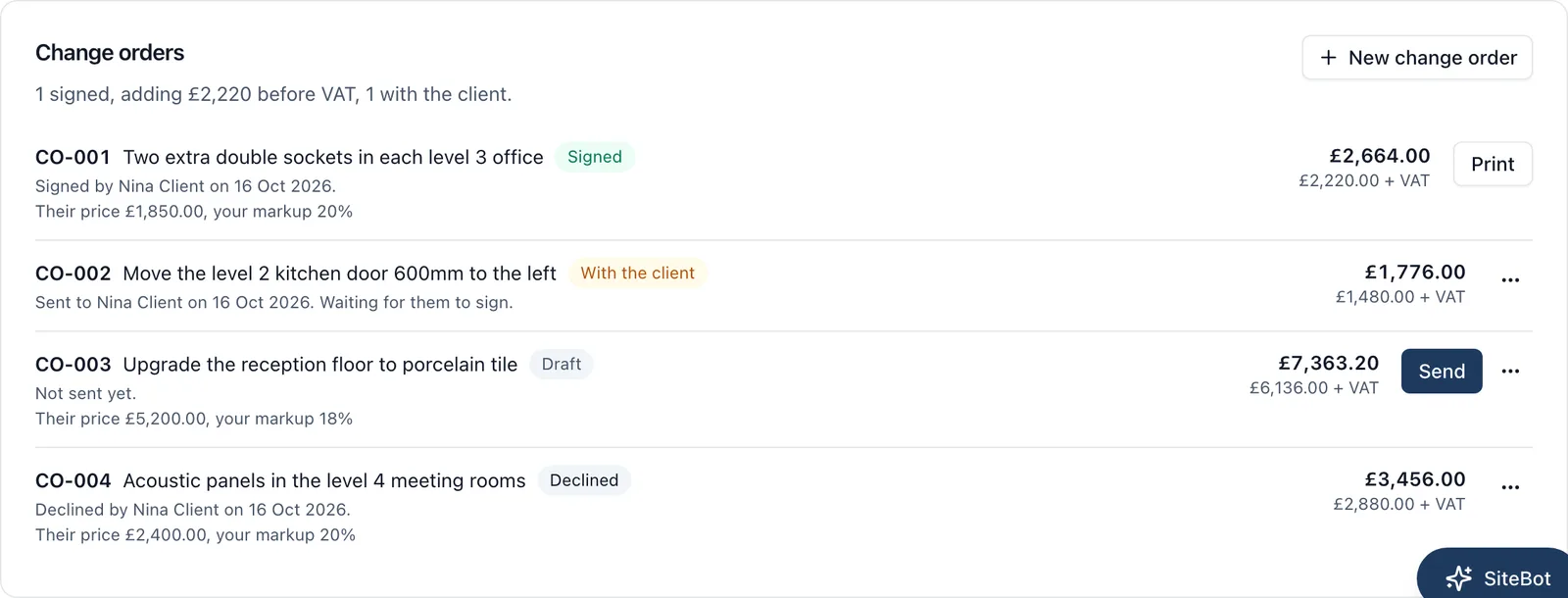
✓Priced from your cost plus your markup. Write what the change is and what it involves, choose who priced it, type their price and your markup, and the price to the client fills in, with the VAT. Round it if you like: what you type is what the client is asked to agree to. See change orders.
✓Signed on the client’s phone, with no account. Send it by email. The client reads it from the link, types their name, draws their signature and ticks to agree, or declines it. They see the change, the price, the VAT and the total, never the subcontractor’s figure or your markup. You are told when they sign or decline.
✓Omissions as credits. Choose Takes off the price, and the change order is saved as a credit, shown with a minus and marked Omission. The client signs it the same way.
✓Numbered and locked. Each one is numbered CO-001, CO-002 and so on, and shows where it stands: draft, with the client, signed, declined or withdrawn. A signed change order cannot be changed, withdrawn or deleted, and it prints with the client’s signature and when they signed. One signed on paper can be recorded as signed.
✓The agreed price, always current. Every signed change order is added to the quote (and every signed omission taken off) to give the agreed price on the Cost Tracker and on the Overview of every job, where the forecast margin is worked out from it.
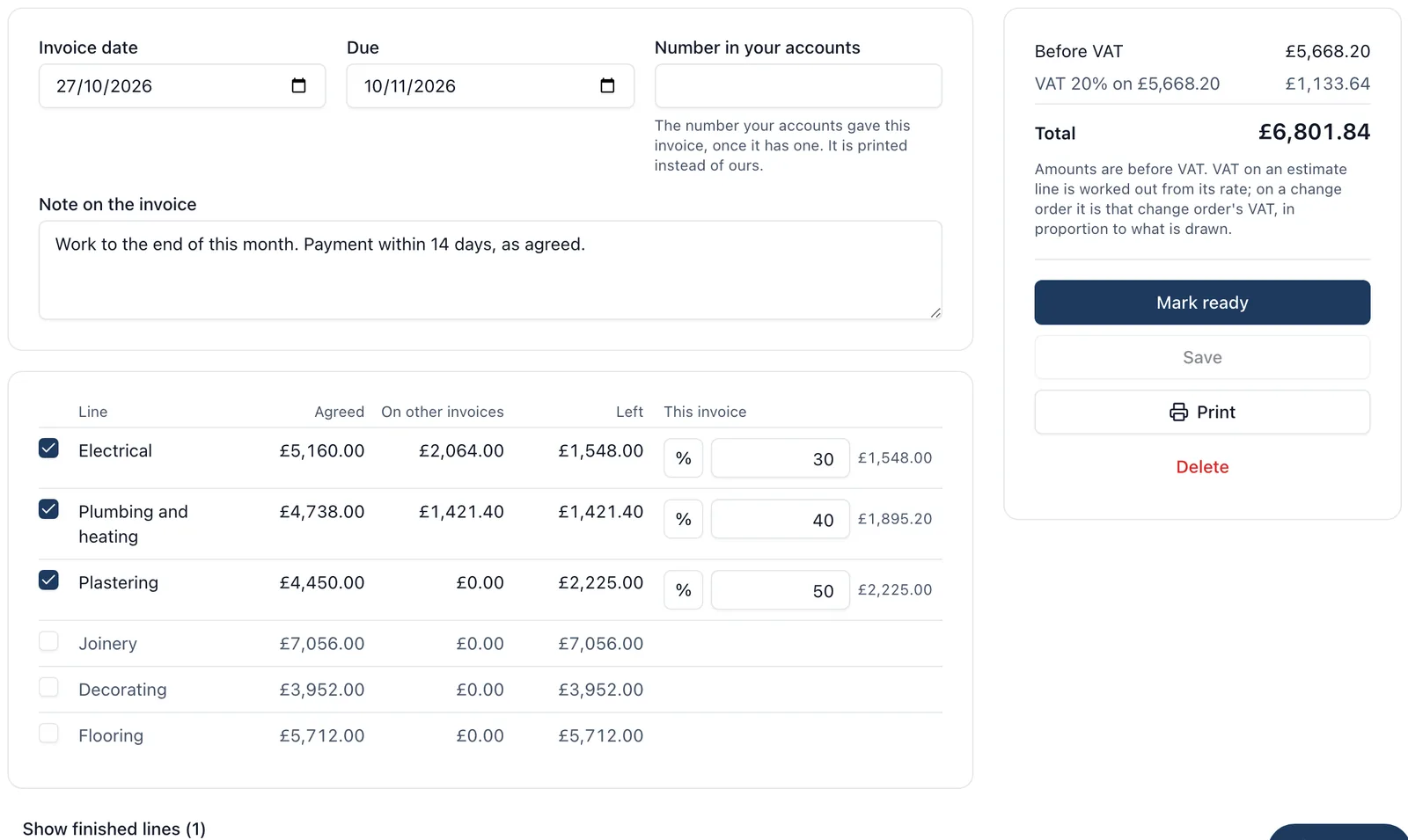
✓Into the next invoice. When you invoice the client month by month, signed change orders are listed after the estimate lines, and you draw a percentage or an amount from each. An omission is drawn as a credit. You cannot draw more than is left on a line, so nothing is billed twice. See invoices to the client.
The original price comes from an estimate the client signs, which becomes the job’s quote once accepted. If a change costs time, the delay register records it on the day, with “Instruction” as a cause. With QuickBooks Online connected, a ready invoice goes to your books when you press Send and the client’s payments are read back onto the job. BuildersAI does not email the invoice to your client or take payments.
Pricing is flat, with no per-user fees: Starter is £149 a month for up to 10 people, Professional is £299 a month for 11 to 50, and Business is £599 a month for 51 to 100, all plus VAT, with a 14-day free trial. See the pricing page.
BuildersAI solution:
See a variation priced, signed on a phone and drawn into the next invoice on a 30-minute demo, using a demo project set up like a real job.
Variations are one part of running the money on a job. For how they fit with estimates, costs, purchase orders and invoices, read our guide to construction cost management software.
FAQ
What is a variation in construction?
A change to the work described in the contract: an addition, an omission, or a change to the specification or method. If the request changes what you are obliged to build, it is a variation, and it should be priced and agreed before the work is done.
How do I price a variation?
Use the rates in your original quote where they apply. Otherwise build it up from labour, materials, plant and subcontractors at cost, add your overheads and profit, and state any extra time on the programme. VAT goes on at the rate for your work.
Can I charge for extra work that was agreed verbally?
Often yes, but the price is much harder to prove. A text saying “go ahead” may show the work was asked for, not the figure. Confirm in writing the same day, and take advice on a disputed sum.
How much should I charge for an omission?
The credit starts from what you priced that work at in your quote, not what it would have cost you. Take off anything already spent that you cannot recover, such as non-returnable materials or a restocking charge, and agree the credit in writing like any other variation.
Does a JCT contract let the client change the work?
Yes. JCT forms such as the Minor Works Building Contract and the Home Owner/Occupier contracts let the client vary the work, and the builder is entitled to a fair valuation for it. Check the variation clause in your own contract for the exact process.
Is a variation the same as a change order?
Yes. Variation (or variation order) is the usual UK term; change order is the American term. BuildersAI calls the feature change orders, and it covers both additions and omissions.
Get Every Variation Signed Before It Is Built
See a change order priced, signed on the client’s phone and drawn into an invoice on a 30-minute demo.
William grew up in a family that builds houses for a living and has been around construction sites for as long as he can remember. He has seen first hand that eight-figure sites are often run on WhatsApp and spreadsheets, and started BuildersAI to cut the invisible costs that take chunks of margin across a site. His aim is for BuildersAI to be the all-in-one site management platform built in the UK, for UK sites.
A monthly invoice on a building job is really a running schedule: what was agreed, what has been billed, what is on this invoice and what is left. Keep that schedule straight and nothing gets billed twice or forgotten.
Eight cost management tools a UK builder is likely to shortlist, compared on estimates, purchase orders, invoicing the client, the app on site and the price. Every competitor fact is sourced and dated.
A valuation is how a builder gets paid for work done before the job is finished. Done well, it is a short, provable list of what was agreed, what has been claimed and what is claimed now. Done badly, it is a number the client argues with for three weeks while you fund their job.
10 min read
Get started
Ready to bring your whole team onto
one simple app?
14-day free trial with every feature, no card and no contract, and your team can be set up
within a day.