Construction Valuations and Interim Payments: A Guide for UK Builders
William Charlesworth-Jones10 min read
Quick Answer
A construction valuation is a monthly assessment of the work done to date, priced against the agreed contract sum, which becomes the builder’s interim payment application. You take each line of the priced estimate or schedule, say what percentage of it is complete, add any signed variations and (where the contract allows) materials on site, then subtract what was valued before to get this month’s claim. If the contract holds retention, typically around 5% according to the government’s research, it is deducted from the total. On most commercial and subcontract work the Housing Grants, Construction and Regeneration Act 1996 sets the payment notice and pay less notice rules, but contracts with a homeowner for work on their own home are largely excluded.
On any job longer than a few weeks, waiting until the end to be paid means funding the client’s building with your own overdraft. This guide is part of our wider guide to construction cost management, and covers how to work out what you are owed each month and claim it so it gets paid.
What Is a Construction Valuation?
A valuation is a statement of the value of the work properly done on a job up to a given date. It is measured against the contract sum, not against what the work has cost you. On a fixed price job that is the whole point: the client pays for progress against the price they agreed, and your margin is whatever is left after your costs.
The valuation turns into money through an interim payment application (or application for payment). On larger jobs the client’s QS or contract administrator checks it and certifies what they agree; on smaller jobs it is simply a monthly invoice that shows its working.
Three figures carry every valuation:
What was agreed: the contract sum, line by line, plus every signed variation.
What has been valued before: the running total of earlier claims.
What is valued now: the work done to date, less what was valued before, which is this month’s claim.
Cost plus work is different: the client pays your actual costs plus a markup rather than progress against a price, which is covered in our guide to cost plus contracts.
How Often Should a Builder Do a Valuation?
Monthly is the norm on UK building work, usually to a fixed valuation date (the last Friday of the month, say) written into the contract. Some jobs use stage payments instead, tied to milestones such as “roof on” or “first fix complete”.
The law backs this up for contracts the Act covers. Section 109 of the Housing Grants, Construction and Regeneration Act 1996 gives a party to a construction contract the right to be paid by instalments, stage payments or other periodic payments, unless the work is agreed to last less than 45 days. If the contract says nothing on how often, the statutory Scheme for Construction Contracts fills the gap.
Whatever the frequency, keep the date fixed: a valuation that drifts a week late is a cash flow problem you created yourself (see our guide to construction cash flow management).
How Do You Value Work Done?
You value against the priced document the client agreed: your estimate, a schedule of works, or a QS’s priced bill. The more lines it has, the easier the valuation, because “Roof, 80% complete” is something a client can walk out and check. “Building works, £23,000” is not.
A simple method that works on most jobs:
Walk the site on the valuation date. Take dated photos of each area. They are your evidence if a figure is queried.
Go line by line through the priced estimate. For each line, decide the percentage complete to date, or the amount if the line is measured (metres of blockwork, number of windows fitted).
Add signed variations. Each signed variation becomes its own line with its own agreed price, valued the same way. Unsigned ones are a separate conversation, not part of this claim. Our guide to construction variations covers getting them signed before the work starts.
Add materials on site, if the contract allows it. Materials delivered and stored properly but not yet fixed can often be included. Many contracts set conditions (protected from the weather, intended for the works, sometimes ownership passing to the client), so check yours before claiming them.
Total the work done to date, deduct retention if the contract holds it, and subtract what was valued before. The difference is this month’s claim.
Add VAT at the rate that applies to the work. HMRC’s VAT Notice 708 sets out which rate applies to which building work. Check unusual jobs with your accountant.
Value what is done, not what was planned. A percentage that matches the programme rather than the building is the fastest way to lose the client’s trust.
What Does a Valuation Look Like? A Worked Example
Here is valuation 2 on a £96,000 office refurbishment for a business client, with one signed variation for an extra steel beam. The valuation date is 31 October.
Line
Agreed
Previously valued
This valuation
Left
Strip out and alterations
£14,000
£14,000 (100%)
£0
£0
Structural works and new openings
£26,000
£13,000 (50%)
£7,800 (to 80%)
£5,200
Roof repairs and rooflights
£12,000
£0
£9,600 (80%)
£2,400
First fix electrics and mechanical
£9,500
£0
£4,750 (50%)
£4,750
Windows and doors
£8,500
£0
£0
£8,500
Partitions and plastering
£6,000
£0
£0
£6,000
Second fix and finishes
£20,000
£0
£0
£20,000
Variation 1: extra steel beam (signed)
£3,200
£0
£3,200 (100%)
£0
Total
£99,200
£27,000
£25,350
£46,850
The four columns always reconcile: what was agreed equals what was valued before, plus this valuation, plus what is left. If they do not, a line has been missed or claimed twice.
If the contract holds 5% retention, the claim works out like this:
Step
Amount
Gross value to date (£27,000 + £25,350)
£52,350.00
Less retention at 5%
£2,617.50
Net value to date
£49,732.50
Less previously paid (£27,000 less 5%)
£25,650.00
Due this valuation, before VAT
£24,082.50
VAT at 20%
£4,816.50
Total to pay
£28,899.00
BuildersAI solution:
In BuildersAI, every invoice to the client is drawn from the lines of the accepted estimate and the signed change orders, and printed with each line’s agreed amount, what was invoiced before, this invoice and what is left. You cannot draw more than is left on a line. See invoices to the client.
Retention is a percentage of each payment that the client holds back as security against defects or the contractor failing to finish. The government’s consultation on retention payments in the construction industry describes it as typically 5% of the amount due, with half released at completion and the other half at the end of the defects liability period, typically 12 to 24 months. The research behind it found an average retention of about 4.8% of contract value (consultation document, 2017).
Practical points for a builder:
Retention is only held if the contract says so. Many small domestic jobs have none.
Diary the release dates (practical completion and the end of the defects period) on the day the contract is signed. Retention is easy to forget to chase.
Show retention held to date on every valuation, so the release figure is never a surprise.
What Are Payment Notices and Pay Less Notices?
For contracts covered by the Act, the 2011 amendments set out a notice process so both sides know what is being paid and why. In outline, and as set out in Part II of the Act:
Payment notice (section 110A). Within five days after each payment due date, the payer (or the payee, if the contract says so) must give a notice stating the sum considered due and how it was calculated.
Default notice (section 110B). If the payer does not give one, the payee can give its own notice, and the final date for payment moves back accordingly.
Pay less notice (section 111). If the payer intends to pay less than the notified sum, it must say so, with its reasons, before the final date for payment. Under the Scheme, where the contract is silent, that is no later than seven days before the final date, and the final date is 17 days after the payment becomes due (Scheme, Part II). Without a valid pay less notice, the notified sum has to be paid.
No “pay when paid” (section 113). A clause making your payment depend on the client being paid by someone else is ineffective, except on insolvency.
The big exception: homeowners. Section 106 says the payment rules do not apply to a construction contract with a residential occupier, meaning a contract principally about work on a house or flat that one of the parties lives in or intends to live in (section 106). So a homeowner’s extension or kitchen is mostly outside these notice rules, and the payment terms are whatever your written contract says. Your contracts with your own subcontractors on that same job are not excluded. That is a good reason to put clear payment terms in every domestic contract.
This is a summary, not legal advice. For a dispute or an unusual contract, speak to a construction solicitor or adviser.
What Are the Most Common Valuation Mistakes?
Over-valuing. Claiming 80% of a line that is 60% done gets cash in early and costs you later: the client’s QS marks it down, trust drops, and every future figure is checked twice. Value what is on site.
Forgetting signed variations. A variation signed in March and never put on a valuation is money you will only see at the final account, if at all. Every signed variation should go straight onto the list of lines.
Claiming unsigned variations. Unsigned extras give the client an easy reason to dispute the whole claim.
No evidence. A percentage with no dated photos behind it is an opinion. Photos from the valuation date close most queries in one message.
Losing track of what has been claimed. When the valuation is rebuilt in a fresh spreadsheet each month, a line gets claimed twice or dropped. The previously valued column has to come from the last valuation, not from memory.
A Valuation Checklist You Can Copy
Job, valuation number and date at the top, then tick each line:
Site walked on the valuation date, dated photos of every area
Every line of the priced estimate listed with its agreed amount
Percentage or measured quantity complete set for each line
Every signed variation added as its own line
Unsigned variations left off (chase signatures separately)
Materials on site included only if the contract allows, with photos
Previously valued column copied from the last valuation
Columns reconcile: agreed = previously valued + this valuation + left
Retention deducted at the contract rate, total held shown
VAT rate checked for this work
Sent by the date in the contract, to the right person
Due date and final date for payment in the diary
Retention release dates in the diary (completion, end of defects period)
How BuildersAI Does It
BuildersAI is the all-in-one site management app for UK builders, and the money side of a job runs from the estimate to the last invoice. There is no separate “valuation certificate” feature. Instead, BuildersAI produces the valuation-style invoice: each monthly invoice to the client is drawn from the agreed lines and printed with the same four columns as the worked example above.
The agreed lines come from the accepted estimate. Price the job in estimates, or import your QS’s priced spreadsheet, and send it on your letterhead. Once the client accepts, it becomes the job’s quote on the Cost Tracker.
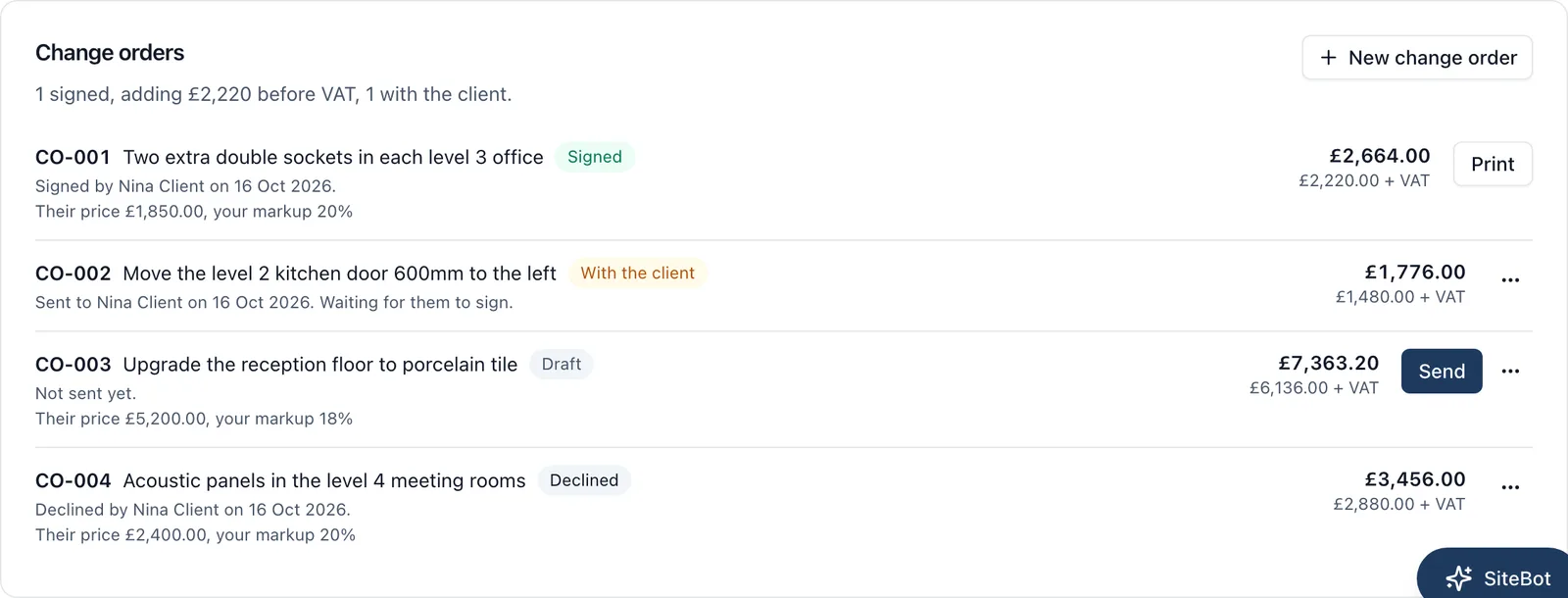
Variations are signed before they are built.Change orders (BuildersAI’s name for variations) are priced, sent and signed by the client on their phone. A signed one is locked and can be drawn on in your invoices, line by line.
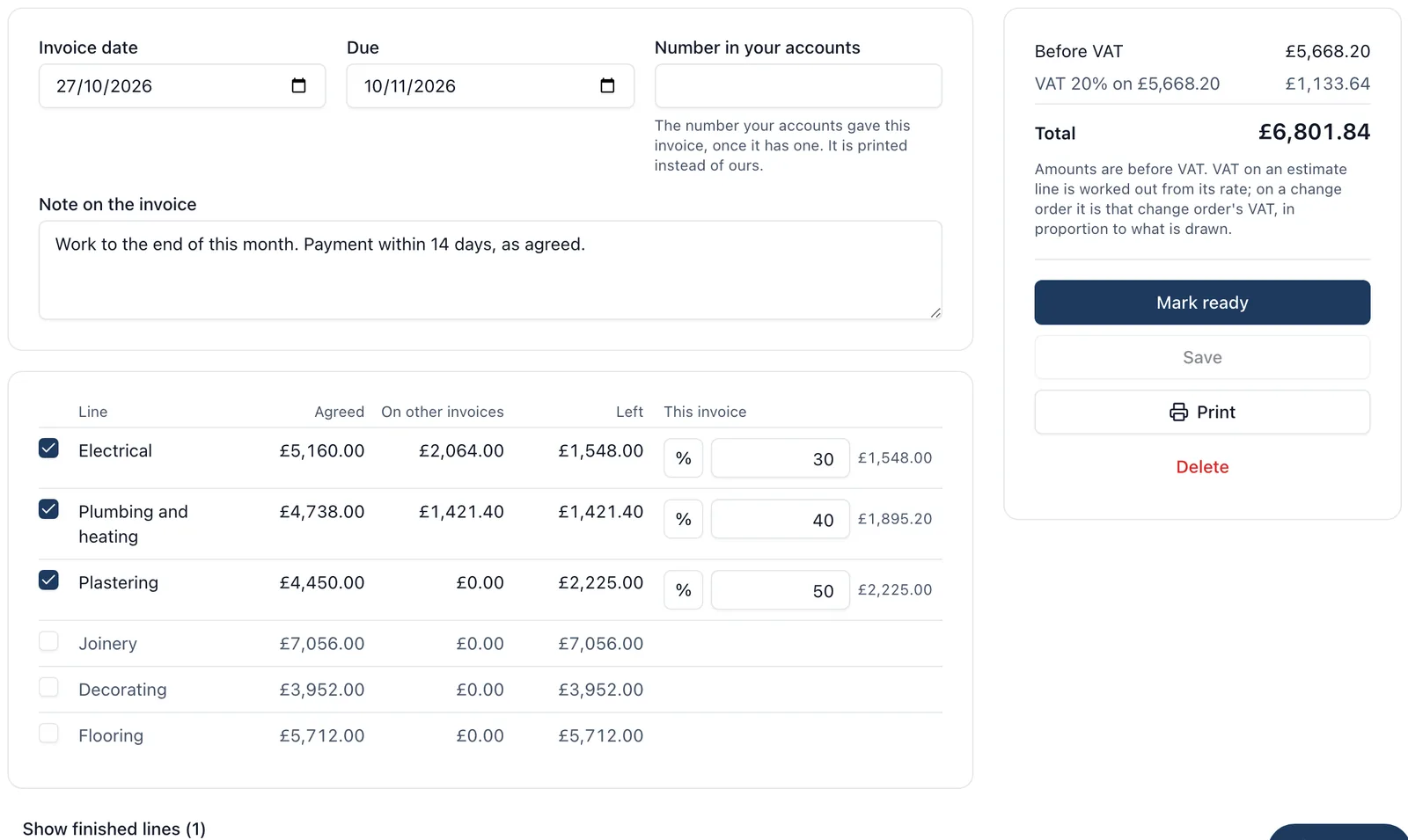
Each month, draw down by percentage or amount. Start a new invoice, tick the lines you are claiming, and type a percentage or a figure for each. Every line shows what was agreed, what is on other invoices (drafts included) and what is left.
You cannot overdraw a line. You are stopped before going past what is left, so nothing is claimed twice and nothing is forgotten.
It prints on your letterhead with each line’s agreed amount, what was invoiced before, this invoice and what is left, with VAT worked out from each line’s own rate.
QuickBooks Online. With QuickBooks Online connected, a ready invoice goes to your books as a draft when you press Send, and the client’s payments are read back onto the job. BuildersAI does not email the invoice to your client and does not take payments: you send it from QuickBooks or print it as you do now.
Fixed price or cost plus. Fixed price jobs draw down the estimate as above. Cost plus jobs invoice every supplier invoice since the last claim plus one markup line instead.
The client’s view of the money. Switch it on and, on a fixed price job, the client sees the agreed price, what they have paid, what is left and each invoice you have marked ready, never your own costs. See the client’s money page.
Signed change orders sit beside the estimate lines, ready to be drawn on in the next invoice.
Two honest limits. Retention is not held back on a BuildersAI invoice, so deduct it in your accounts package. And there is no separate materials on site line: if your contract allows it, draw the amount from the relevant line. Because invoices count on the Overview of every job beside what has been spent, you can also see whether billing is keeping up with spend, which our guides to job profitability and cost value reconciliation build on.
The step by step is on the estimates help page. Pricing is flat, with no per-user fees: £149 a month for up to 10 people, £299 for 11 to 50 and £599 for 51 to 100, all plus VAT, with a 14-day free trial. See the pricing page.
BuildersAI solution:
See a month’s valuation-style invoice drawn from an estimate and a signed change order on a 30-minute demo. For how the rest of the job’s money fits together, read our guide to construction cost management software and our guide to invoicing month by month.
A monthly assessment of the value of the work done to date on a job, priced against the agreed contract sum and signed variations. It is the basis of the builder’s interim payment application, and this month’s claim is the value to date less what was valued before.
How often should a builder submit a valuation?
Usually monthly, on a fixed date set in the contract. Some jobs use stage payments tied to milestones instead. Under the Construction Act, a party is entitled to periodic payments unless the work is agreed to last less than 45 days.
What is the typical retention rate in the UK?
The government’s 2017 consultation on retentions describes retention as typically 5%, with research finding an average of about 4.8% of contract value. Half is customarily released at completion and half at the end of the defects liability period.
Can I include materials on site in a valuation?
Often, if the contract allows it. Most contracts that do set conditions, such as the materials being intended for the works and properly stored and protected. Check your contract before claiming them and keep dated photos.
Do payment notices and pay less notices apply to homeowner jobs?
Mostly not. Section 106 of the Housing Grants, Construction and Regeneration Act 1996 excludes contracts with a residential occupier for work on their own home. The payment terms are whatever your contract says, so write them down clearly. Your contracts with subcontractors are still covered.
Can software do my monthly valuation?
It can do the arithmetic and the record keeping. In BuildersAI each invoice to the client is drawn by percentage or amount from the accepted estimate and signed change orders, cannot overdraw a line, and prints on your letterhead with what was agreed, invoiced before, this invoice and left. You still walk the site and decide the percentages.
Valuations Drawn Straight From the Estimate
See a monthly invoice drawn from estimate lines and signed change orders on a 30-minute demo.
William grew up in a family that builds houses for a living and has been around construction sites for as long as he can remember. He has seen first hand that eight-figure sites are often run on WhatsApp and spreadsheets, and started BuildersAI to cut the invisible costs that take chunks of margin across a site. His aim is for BuildersAI to be the all-in-one site management platform built in the UK, for UK sites.
A monthly invoice on a building job is really a running schedule: what was agreed, what has been billed, what is on this invoice and what is left. Keep that schedule straight and nothing gets billed twice or forgotten.
Eight cost management tools a UK builder is likely to shortlist, compared on estimates, purchase orders, invoicing the client, the app on site and the price. Every competitor fact is sourced and dated.
Cash flow problems kill more construction businesses than bad workmanship ever will. This guide breaks down practical cash flow management strategies for UK builders, from payment terms that actually protect you, to forecasting methods that prevent nasty surprises.
14 min read
Get started
Ready to bring your whole team onto
one simple app?
14-day free trial with every feature, no card and no contract, and your team can be set up
within a day.