Project Management Software: How Project Managers Can Securely Harness AI
William Charlesworth-Jones8 min read
Quick Answer
59% of UK project management software buyers say AI drove their last purchase decision, and 85% report positive ROI. But almost half anticipate problems with adoption, and security is the number one concern. Construction PMs who get a return from AI construction software focus on fit over features, invest in proper onboarding, and ask the right security questions before signing.
AI in construction project management software has moved from marketing buzzword to everyday reality. According to research from Capterra, 59% of UK project management software buyers say AI spurred them into their last purchase, and 36% are specifically raising budgets to adopt new AI tools.
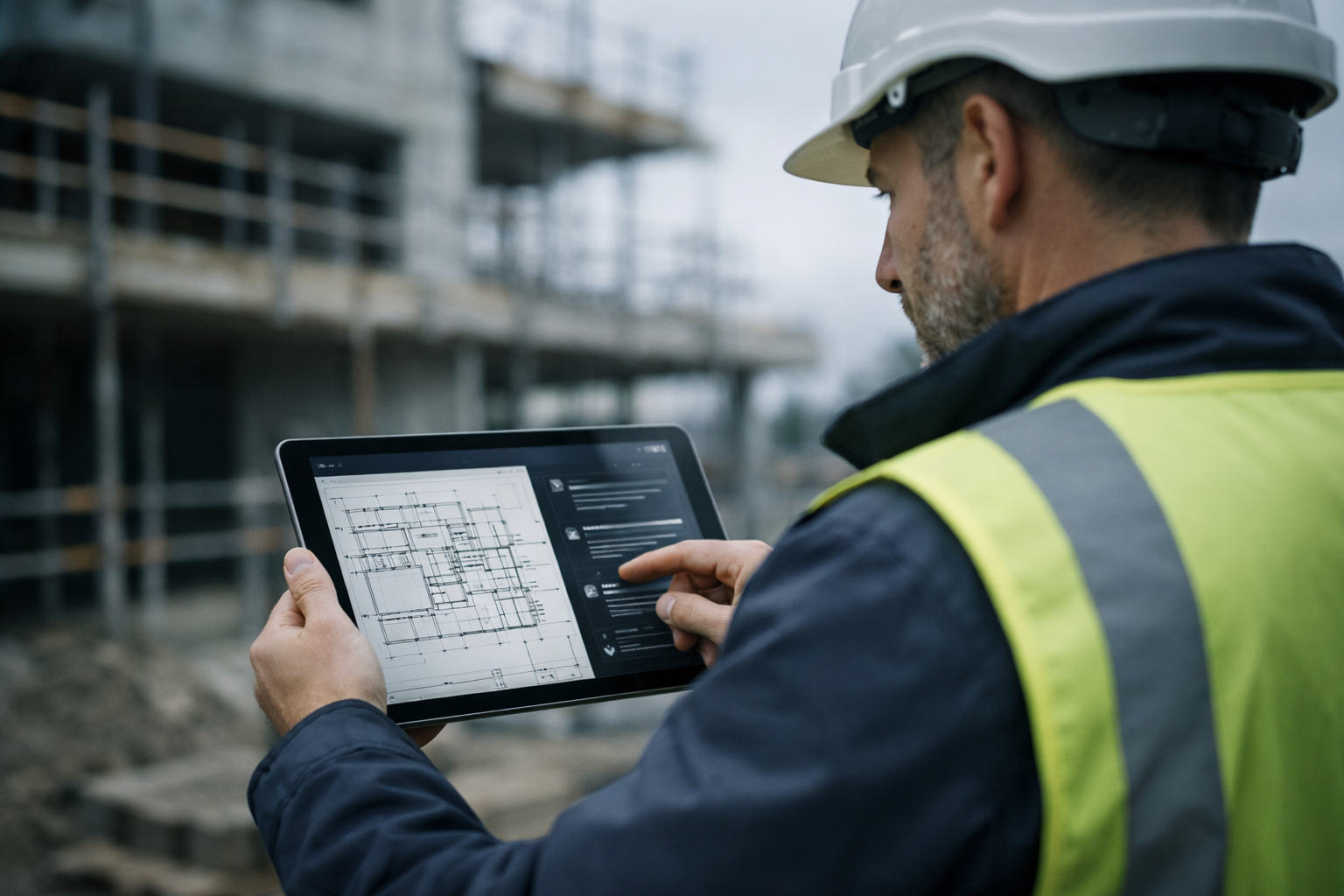
For construction project managers, that shift is visible on site. Drawing queries, daily briefings, audit trail searches, and document verification are all areas where AI construction software is now doing work that used to take real time from real people.
But the same research shows a problem: almost half of UK PMs (48%) anticipate struggles to implement AI effectively. Skills gaps, poor onboarding, and workflow misalignment are the most common culprits. For construction teams who cannot afford disruption mid-project, those are serious risks.
AI in Construction Project Management Software Is Already Here
Large language models (LLMs), automation, and predictive analytics are no longer experimental features. Most major construction project management AI tools now include them as standard, and the gains on site are real.
The practical applications for construction PMs include:
Document queries: Ask a question about a drawing, specification, or contract in plain English and get an instant answer with a source reference
Daily briefings: AI surfaces overnight activity, new uploads, and flagged issues into a morning summary
Audit trail search: “Who approved the variation for the additional groundworks?” becomes a two-second query rather than a 20-minute search
Risk flagging: Patterns across site activity flagged automatically, a repeated question about the same drawing revision, a trade consistently logging issues in the same area
The ROI case is strong. Capterra found 85% of PM software buyers report positive returns from AI tools. In our own experience working with UK construction teams, the same drawing-related question is often asked six to twelve times a week across a site, a direct result of information being scattered across WhatsApp groups, email chains, and multiple document versions. That is exactly the problem AI site management tools are built to solve.
Start Using AI on Your Site
BuildersAI is built for live construction sites, not offices. Ask questions about drawings, get source-backed answers, and remove the constant back-and-forth across WhatsApp and email.
Where Construction Teams Waste the Most Time (and How AI Fixes It)
Before looking at types of AI tools, it is worth naming the specific problems they solve. Construction project managers do not lose time to one big inefficiency, they lose it to dozens of small ones that compound across a site.
Repeated drawing queries. The same question about a drawing revision gets asked by multiple trades on multiple days. Without a central source of truth, every query lands with the PM.
Version confusion. Teams work from outdated drawings because no one knows which revision is current. On UK sites, rework from version errors costs an average of 5% of total project costs.
WhatsApp fragmentation. Critical decisions and approvals are buried in group chats. Finding a specific message from three weeks ago takes 20 minutes and still might not surface the right information.
Approval tracking delays. Variations, RFIs, and sign-offs get lost between email, chat, and verbal conversation. When a dispute arises, there is no audit trail to rely on.
Unlike generic AI tools, construction environments introduce specific constraints, offline working, fragmented communication, and high-stakes decisions that require purpose-built systems. General-purpose AI applied to construction documents will answer some questions but will not understand drawing revision hierarchies, CIS requirements, or site-specific workflows.
Types of AI Used in Construction Project Management Software
Not all AI in construction software works the same way. Understanding the different types helps project managers choose tools that match their actual needs.
Large language models (LLMs) are the most common application. These power document query tools: upload your drawings, specs, and site documents, and ask questions in plain English. The AI reads the documents and returns answers with references. This is the most immediately useful AI for construction project managers.
Computer vision analyses site photos and drawings. It can identify progress against plans, flag safety issues in site images, and detect changes between drawing revisions. This is more advanced and less widely available in mainstream construction AI tools, but increasingly common in larger platforms.
Predictive analytics uses historical project data to forecast delays, cost overruns, and resource gaps before they happen. The value is in early warning: a flag that a groundworks package is tracking two weeks late before it becomes a programme crisis.
Most construction AI tools today focus primarily on LLMs for document management. Computer vision and predictive analytics are emerging capabilities rather than standard features.
Why AI Adoption Goes Wrong in Construction
Getting a return on AI construction software requires more than buying the right tool. Capterra’s research shows the most common reasons adoption fails are skills gaps, insufficient vendor onboarding, and failure to align the technology with existing workflows.
In construction, those problems are amplified. Site teams work under time pressure, in variable conditions, often without reliable connectivity. A tool that requires significant training or a stable internet connection will not survive contact with a real site.
The other common mistake is choosing software based on feature lists rather than fit. A platform with extensive AI capabilities that requires two weeks to onboard is less useful on a live project than a simpler tool your team can use from day one.
Key questions to ask before adopting any AI tool:
How long does onboarding actually take, and who handles it?
Does the AI work offline on site?
Can your site team use it without formal training?
Is the AI trained specifically on construction documents, or is it a general tool with a construction label?
The Security Problem
Security is the most cited concern around AI adoption in construction project management, and rightly so. Capterra found 72% of buyers rank security as highly critical, with 51% saying security concerns directly influenced their software decision.
Project management systems hold sensitive information: contract values, subcontractor rates, client details, structural drawings, and compliance records. AI features increase the surface area for risk, particularly around API connections, access control, and how data is used to train models.
Key security questions for construction PMs:
Where is the data stored? GDPR compliance requires your project data to be held on servers within the UK or EU. Many AI platforms are US-based and default to US data centres. This matters for your firm and your clients.
Does your data train their model? There is a meaningful difference between AI that learns from your site’s own data privately, and AI that feeds your information into a shared model used by other companies. The second creates real risk of cross-client data exposure.
Does the AI cite its sources? An AI that gives confident answers with no references is guessing. On a site where a wrong answer about a structural specification or fire stopping detail can cause costly mistakes, source referencing is not optional.
What is the vendor’s security track record? Ask directly whether they have experienced data breaches and how they secure their API connections. A vendor who cannot answer clearly is not ready for live project data.
What Good Looks Like in Construction AI Software
The construction AI project management tools that deliver real results share a few characteristics.
They are built for construction documents specifically. A tool trained to understand drawing revisions, RFIs, specifications, and site diaries will give more reliable answers than a general-purpose LLM pointed at a folder of PDFs.
They work offline. Rural sites, basements, and plant rooms have no signal. AI site management tools that require connectivity are not site tools.
They store data in the EU. GDPR is not optional for UK construction firms working with local authorities or larger developers.
They handle onboarding. Your site team’s job is not to configure software. A provider who sends you a login and a help centre link is not ready for construction.
Questions to Ask Before You Buy Construction AI Software
Use this checklist before committing to any AI-enabled construction project management software:
Where is our data stored, and can you confirm GDPR compliance?
Does our data train your AI model, or stay private to our account?
Does the AI cite the source document for every answer?
What does onboarding look like, and who handles it?
Does the tool work offline on site?
Have you experienced any data breaches? How do you secure your APIs?
Has the tool been used on live UK construction sites?
A vendor who cannot answer these clearly is not ready for a live site environment.
See BuildersAI on Your Site
BuildersAI is purpose-built for UK construction teams. EU data storage, AI that cites its sources, offline capability, and full onboarding handled by us. Your team can start using it on site from day one.
AI in construction project management refers to software features that automate or assist with tasks that would otherwise require manual effort. The most common applications are large language models (LLMs) that answer questions about site documents, predictive analytics that forecast delays and cost overruns, and computer vision that analyses site photos for progress and safety issues. In practice, the most useful current application for most construction PMs is document query AI: ask a question in plain English, get an instant answer with a source reference.
Is AI safe for construction project data?
It depends on the tool. AI construction software that stores data within the UK or EU, keeps your data private to your account, and cites its sources is safe and genuinely useful. The risks come from generic AI tools that are not designed for construction, particularly around data storage location and whether your information is used to train a shared model. Always confirm GDPR compliance and data residency before signing up.
What are the best AI tools for construction project managers?
The best AI tools for construction project managers are those built specifically for construction documents rather than general-purpose AI adapted for the sector. Look for tools that work offline, handle onboarding for your whole site team, store data in the EU, and cite sources for every answer. BuildersAI is designed specifically for UK construction teams and covers document queries, site presence tracking, and team communication in one platform.
Can AI read construction drawings?
Yes. AI construction software using large language models can read and query PDF drawings, specifications, and other site documents. You can ask questions like “What is the U-value for the external wall on Block B?” and get an answer with the source document referenced. More advanced tools using computer vision can also analyse drawings visually, identifying changes between revisions or checking details against specifications.
Does AI work offline on construction sites?
It depends on the tool. Many AI platforms require a live internet connection, which makes them unreliable on rural sites, in basements, or in plant rooms with no signal. The best construction AI tools are designed to work offline, syncing when connectivity is restored. This is a critical question to ask any vendor before adopting AI project management software for site use.
What is the ROI on AI construction project management software?
Capterra research found 85% of PM software buyers report positive ROI from AI tools. In construction specifically, the biggest gains come from reducing the time project managers spend answering repeated questions, searching for documents, and chasing audit trails. On UK construction sites, the same drawing-related question is often asked six to twelve times per week across a site, AI eliminates that friction entirely.
Ready to fix this on your site?
Stop losing hours to coordination chaos
BuildersAI puts drawings, tasks, and updates on every phone on site. 14-day free trial, every feature, no card needed.
Founder of BuildersAI with a background in construction and economics. After watching coordination chaos waste hours on every site, he set out to build AI tools that actually work for UK builders.
84% of construction software integration projects fail. Learn why most construction technology doesn't get adopted and what patterns separate successful implementations from expensive failures.
Independent comparison of construction PM software for UK contractors. Covers pricing, CIS compliance, offline capability, and feature analysis for firms of all sizes.
We tested construction apps on three UK sites over two weeks. Here are the best apps for site managers, subcontractors, and safety officers - with honest assessments of offline capability and real-world usability.
7 min read
Get started
Ready to bring your whole team onto
one simple app?
14-day free trial with every feature, no card and no contract, and your team can be set up
within a day.