Construction Site Diary Apps UK: What to Record, How Long to Keep It, and the Best Tools 2026
William Charlesworth-Jones8 min read
Quick Answer
A construction site diary is a dated daily record of what actually happened on site: weather, who attended, work done, deliveries, delays and instructions. It is not usually a statutory requirement in the UK, but it is expected under JCT and NEC style contracts and is often the deciding evidence in delay claims and disputes. Common practice is to keep site records for at least 6 years after completion, or 12 years for contracts signed as deeds; BuildersAI keeps diary records for seven years. The best modern approach is a site diary app that builds the record automatically from site activity; BuildersAI does this from photos, tasks, check-ins and weather, with a 14-day free trial.
What Is a Construction Site Diary?
A construction site diary is a contemporaneous daily record of everything material that happens on a construction site: the weather, who was there, what work was done and where, what arrived, what went wrong and what instructions were given. “Contemporaneous” is the important word. A diary written on the day carries weight; a reconstruction written three months later, when a claim lands, carries very little.
On UK sites the diary goes by several names: daily report, daily log, site record. They are all the same document, and its job is to answer one question reliably, months or years later: what actually happened on site on this date? Delay claims, extension of time requests, payment disputes, insurance claims and HSE investigations all turn on that day-by-day record. Teams that run a disciplined short-interval planning routine tend to keep better diaries too, because the plan and the record are two halves of the same habit: what we said we would do, and what we actually did.
What Should a Site Diary Record Each Day?
A good site diary records eight things every working day: weather, attendance, work completed by area, deliveries, delays and their causes, visitors, instructions received, and photos. In full:
Weather. Conditions morning and afternoon, and any hours lost to it. Weather is the most common ground for extension of time claims, and the claim stands or falls on the daily record.
Who was on site. Your own team and each subcontractor, with numbers per trade.
Work done, by area or plot. Not “good progress” but “plot 4: first fix electrics complete; plot 5: plasterboarding to first floor, two rooms remaining.”
Deliveries and plant. What arrived, from whom, whether it was right, and any hired plant standing idle.
Delays and their causes. What stopped, for how long, and why: late information, failed delivery, no access, weather, another trade not clear. The single most valuable line in the diary.
Visitors. Building control, client, architect, HSE, utility providers: who came, when and why.
Instructions received. Verbal instructions from the client, architect or contract administrator, recorded on the day with who gave them.
Photos. Dated, and tied to the location they show. One photo of a covered-up detail can settle an argument that words never would.
Ten focused minutes covers all eight. What fails on most sites is not knowing what to record; it is doing it every day, including the busy ones, which is exactly when the record matters most. Our guide to reducing construction delays shows why the delay lines in particular repay the effort many times over.
Is a Site Diary a Legal Requirement in the UK?
A site diary is not generally a statutory requirement for most UK construction work, but it is contractually expected under JCT and NEC style contracts and is invaluable evidence in disputes, delay claims and HSE investigations. No law says every site must keep a daily diary. In practice, three forces make it close to mandatory anyway:
Contract terms. Most standard forms require progress records in some form. NEC contracts run on prompt, evidenced communication: early warnings and compensation events are hard to substantiate without a daily record, and JCT extension of time and loss and expense claims rest on the same foundation.
Disputes and adjudication. Adjudicators and courts consistently prefer the party with contemporaneous records. If the other side has a daily diary and you have recollections, you start behind.
Investigations. After an incident, the HSE will want to know who was on site, what work was underway and what controls were in place. A dated diary with attendance and photos answers in minutes what would otherwise take weeks to reconstruct, alongside the statutory records covered in our construction compliance guide.
This is general information, not legal advice. Check your own contract terms, because amended contracts often spell out record-keeping obligations explicitly, and speak to a construction solicitor for anything contentious.
How Long Should Site Records Be Kept?
Common UK practice is to keep site records for at least 6 years after completion for contracts signed as simple contracts, and 12 years for contracts executed as deeds, matching the limitation periods for contract claims under the Limitation Act 1980. Many contractors keep records longer, because latent defect claims and final account arguments can surface late, and because storage is now effectively free.
The practical problem was never the policy; it was the shoebox. Paper diaries get damp, lost, or left in a departing site manager’s van. A digital diary removes the storage question entirely: BuildersAI keeps site diary records for seven years as standard, searchable the whole time, so any given Tuesday three years ago is a search away rather than an afternoon in the archive.
Treat retention periods as common practice rather than legal advice, and check whether your contract, insurer or client imposes a longer requirement.
Paper Diary or Diary App: Which Is Better?
A diary app beats paper for every purpose a site diary actually serves: it is legible, searchable, backed up, timestamped, and it attaches photos to the day they were taken. Paper’s one genuine advantage is that it never runs out of battery, and it is a real advantage right up until the diary gets wet, lost or left blank for a fortnight.
The comparison that matters:
Paper diary
Site diary app
Written every day
Depends entirely on habit
Prompted, or built automatically
Legible in three years
Sometimes
Always
Searchable
No
Yes, by date, word or photo
Photos attached to the day
Stapled, if at all
Automatic, dated and located
Survives loss or damage
No
Backed up
Sharable in a dispute
Photocopies
Printable day view or export
Timestamped
Claimed
Recorded
The real failure mode
Paper diaries do not fail because paper is bad. They fail because the record depends on one person remembering, every day, when they are tired. A diary app used as a blank page inherits the same weakness. The strongest diaries are the ones the site builds as a by-product of working.
What Are the Best Site Diary Apps in the UK?
The best site diary apps for UK contractors are BuildersAI, Raken, PlanRadar and the dedicated Site Diary apps, and the right one depends on whether you want a diary that is filled in or a diary that fills itself.
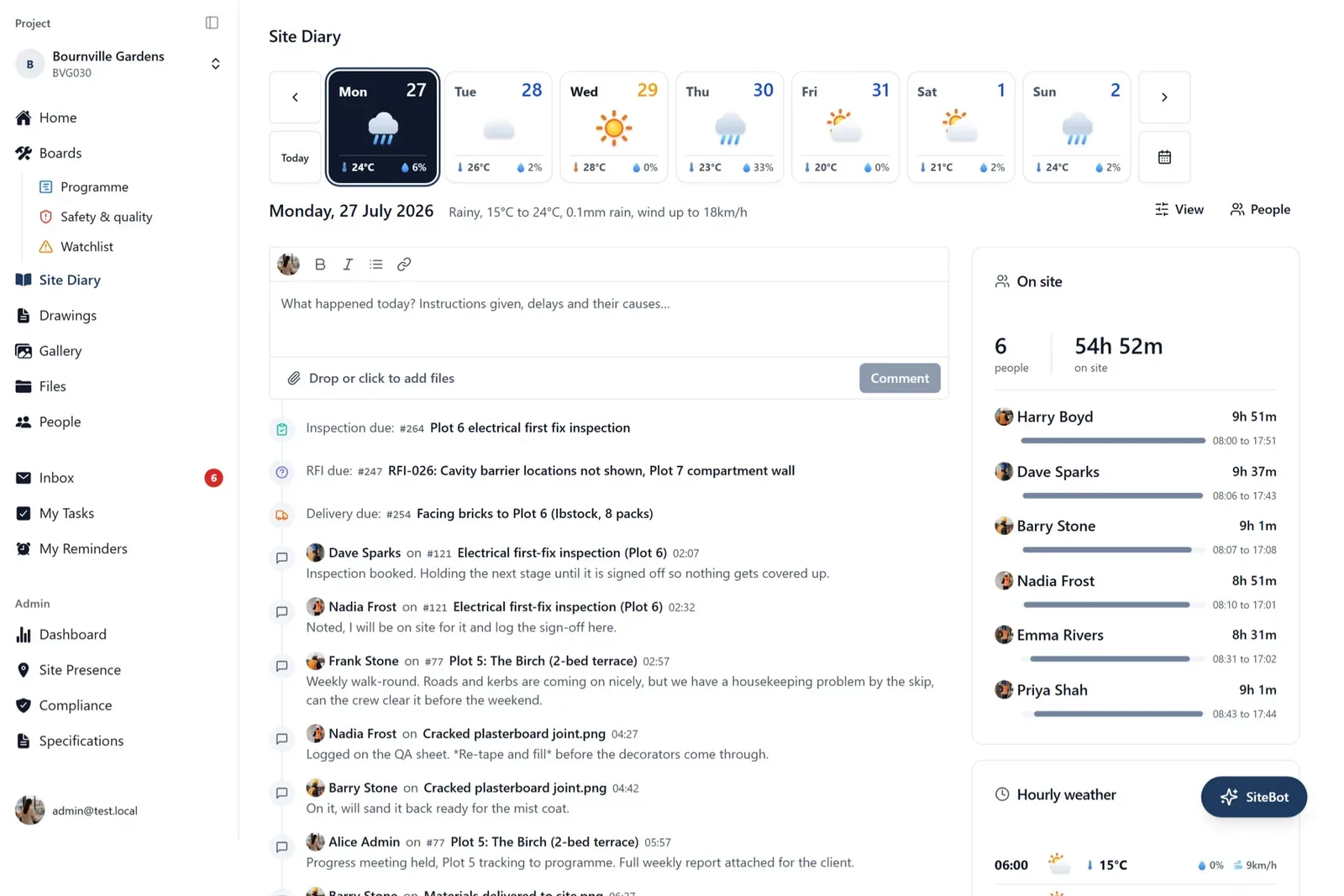
1. BuildersAI. Built for UK SME contractors, and its differentiator is that the diary writes itself. Every photo, completed task, check-in and weather reading lands in that day’s record automatically; the site manager adds manual entries and comments on top rather than starting from a blank page. A day finder and search cover the whole written record, any day prints as a formatted day view for a client or an adjudicator, and records are kept seven years. Because the diary sits alongside the drawings, boards, timesheets and CSCS tracking, the SiteBot assistant can answer “what happened on site yesterday” directly from it. 14-day free trial with every feature and no card, then flat pricing with no per-user fees: Starter £149/month for up to 10 users, Professional £299 for up to 50, Business £599 for up to 100.
2. Raken. A US-origin daily reporting specialist, strong on polished daily reports and collecting logs from subcontractors. Well regarded for reporting workflows, though it is priced per user and its defaults lean American rather than UK.
3. PlanRadar. A European field management platform with configurable diary and report templates alongside snagging and document tools. Capable and flexible, but it is a broad platform priced per user, and the diary is a form to fill in rather than a record that builds itself.
4. Site Diary apps. Several dedicated apps do one thing: replace the paper diary with a structured digital form. Simple, cheap and quick to adopt, and a genuine upgrade on paper, but they stand alone: no link to your drawings, tasks, photos or team, and the daily entry still depends on someone remembering.
The honest test for any of them: open the diary for a random Tuesday six weeks ago. If the entry is full, the tool is working. If it is blank, you have bought a digital version of the empty page.
Site diary essentials at a glance
Daily items to record8
Typical UK retention practice6 to 12 years
BuildersAI record retention7 years
Time for a full daily entryAbout 10 minutes
See a site diary that writes itself
Sign up and open the Bournville Gardens demo project: go straight to its site diary and see a filled day, built automatically from photos, tasks, check-ins and weather, with the printable day view one tap away. The trial runs 14 days, covers every feature and needs no card. For a walkthrough instead, book a 30-minute demo.
Yes. Contemporaneous site records carry real evidential weight in adjudication, arbitration and litigation, and tribunals routinely prefer the party whose account is backed by dated daily records over one relying on recollection. Entries made on the day, with photos and named people, are the strongest form. This is general information rather than legal advice; take advice on any live dispute.
Who should fill in the site diary?
The site manager or foreman running the site each day owns the diary, because they see the whole picture: attendance, deliveries, delays and instructions. An app that pulls in photos, check-ins and completed tasks automatically reduces that job to reviewing the day and adding what only a person would know.
What is the difference between a site diary and a daily report?
In UK usage they are essentially the same document: a dated daily record of site activity. “Daily report” tends to mean a formatted version sent to a client or head office, while “site diary” means the working record kept on site. A good system produces both from one entry, which is what a printable day view is for.
Do subcontractors need to keep their own site diary?
It is strongly in their interest. A subcontractor claiming for delay or disruption needs their own record of attendance, work done and hours lost; relying on the main contractor’s diary means relying on the other side’s evidence. Many subcontracts also require daily records or allocation sheets, so check the terms.
Are digital site diaries accepted for NEC and JCT contracts?
Yes. Neither NEC nor JCT standard forms require records to be on paper; they care that records exist, are made promptly and can be produced. A digital diary with timestamps and attached photos typically serves an early warning or extension of time claim better than a handwritten book. Check for any amended clauses that specify a format.
What happens if there is no site diary during a dispute?
The party without records has to reconstruct events from emails, invoices, phone photos and memory, which is slow, expensive and unconvincing next to a daily record. Delay claims are the classic casualty: entitlement may be real but unprovable. Adjudication timescales are short, so the side that can produce its evidence quickly starts with a substantial advantage.
How much does a site diary app cost in the UK?
Dedicated diary apps and per-user platforms typically run from a few pounds to tens of pounds per user per month, which adds up quickly on a 20-person site. BuildersAI includes the site diary in flat-priced plans with no per-user fees: after a 14-day free trial, Starter is £149/month for up to 10 users, Professional £299 for up to 50 and Business £599 for up to 100.
Ready to fix this on your site?
Stop losing hours to coordination chaos
BuildersAI puts drawings, tasks, and updates on every phone on site. 14-day free trial, every feature, no card needed.
Founder of BuildersAI with a background in construction and economics. After watching coordination chaos waste hours on every site, he set out to build AI tools that actually work for UK builders.
The master programme says what should happen this quarter. Short-interval planning is how good sites decide what actually happens this week, and it is the single biggest difference between sites that flow and sites that firefight.
HSE issued 8,000+ enforcement notices to construction firms in 2024. Learn how to track CSCS cards, certifications, and training records to stay compliant and avoid costly fines.
98% of new UK homes have defects at handover, averaging 100+ snags per dwelling. Learn how to create effective snagging lists, conduct inspections, and reduce callbacks.
15 min read
Get started
Ready to bring your whole team onto
one simple app?
14-day free trial with every feature, no card and no contract, and your team can be set up
within a day.