The Future of AI in Construction: What's Actually Coming (And What's Just Hype)
William Charlesworth-Jones12 min read
AI in construction promises revolutionary changes, but what’s realistic for UK builders right now? The construction industry has heard every promise: robots building entire houses, drones managing sites autonomously, AI eliminating all project delays. Most of it is either years away or fundamentally misunderstands how construction actually works.
But some AI developments are genuinely transformative and arriving faster than people realise. Several tools are already delivering measurable results on UK building sites today and will become industry standard within the next 1-3 years.
This guide separates realistic near-term improvements from marketing hype and science fiction. We examine what AI in construction is actually ready to deliver based on current deployment data, technological readiness, and real-world ROI from UK projects.
What’s Actually Coming: Real AI Advances (1-3 Years)
These aren’t predictions or aspirations. They’re technologies already working in pilot projects that will reach mainstream adoption within 36 months on UK construction sites.
1. AI Design Clash Detection (Already Here, Getting Better)
Clash detection isn’t new. Autodesk Navisworks and similar tools have done it for years. What’s changing is AI that identifies not just geometric clashes but coordination issues.
Current tools find when a pipe intersects a beam. Next-generation AI, like what BuildersAI is developing, spots problems like: “This MEP layout will require the electrician to work overhead while the plumber works below in the same space, so a schedule conflict is likely.”
Impact for builders
Typical savings: £15,000-£40,000 per project in reduced rework costs.
2. Automated Progress Monitoring from Photos
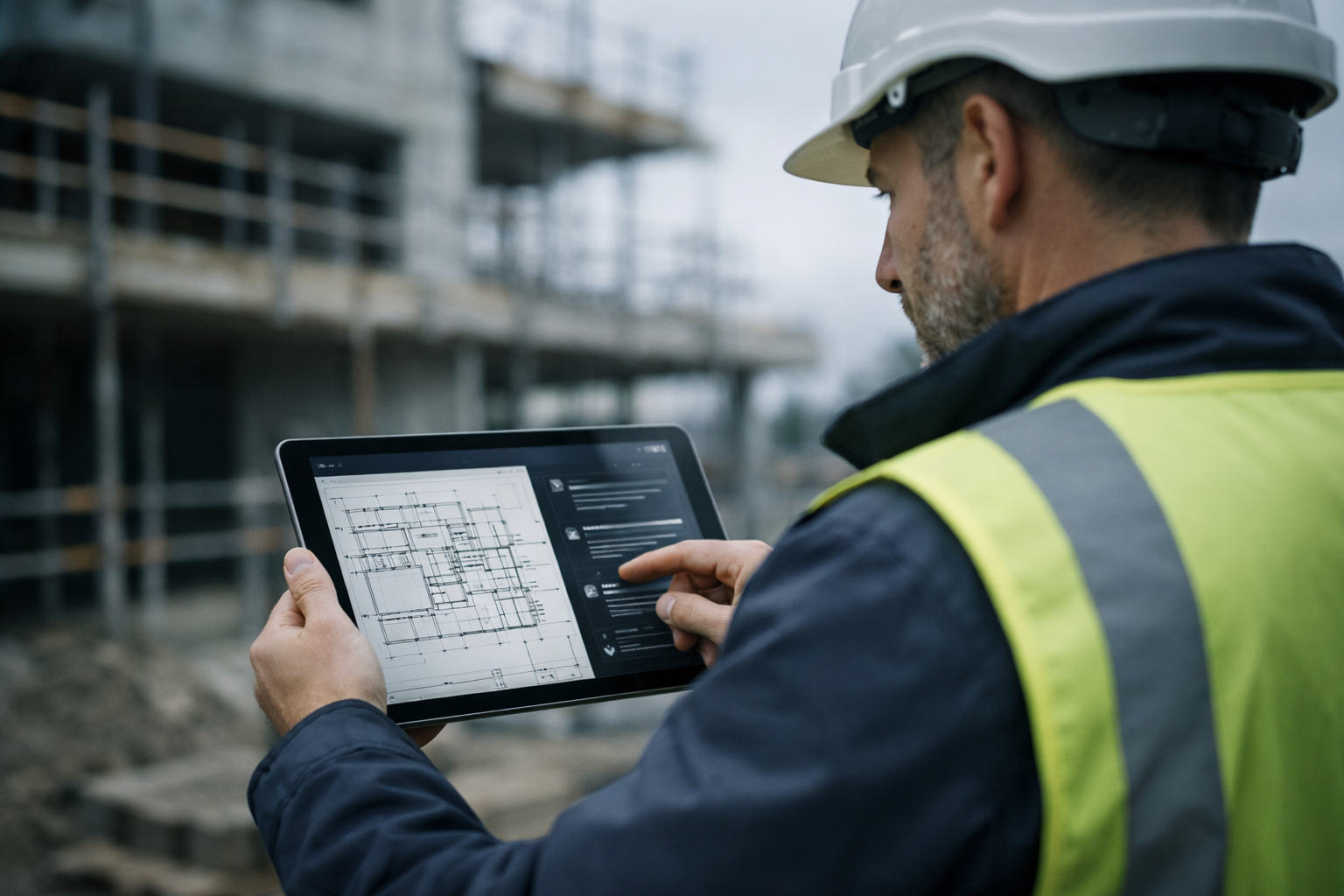
Walking the site with a tablet, manually updating completion percentages, comparing what’s built against drawings takes hours weekly. AI is automating it.
Simply take photos (or use mounted cameras or drones), and AI compares what it sees against the BIM model or 2D drawings. It calculates completion percentages, identifies what’s been installed, spots deviations from design, and flags potential quality issues.
Current reality: AI photo-based progress monitoring is already available and delivering results. BuildersAI includes this functionality as part of our all-in-one platform, so you don’t need to pay for multiple separate tools. Accuracy is 85-90% for basic progress tracking and improving rapidly.
3. Predictive Delay Detection
Most projects identify delays after they’ve happened. “We’re behind schedule” is a retrospective observation. AI is making it predictive.
By analysing current progress, resource allocation, weather forecasts, material delivery schedules, and historical project data, AI can flag: “Based on current concrete pour rates and upcoming weather, you’ll miss the floor slab deadline by 4 days unless you add labour or work weekend shifts.”
4. Intelligent Document Search
You’ve got 2,000 pages of specs, contracts, and drawings. You need one specific detail about fire door specifications. Today’s AI can find it in seconds by understanding context, not just keywords.
According to Federation of Master Builders research, builders waste 15-20 hours per week searching for project information that AI could find instantly.
5. Automated Safety Monitoring
Site cameras with AI are already detecting safety violations in real time: workers without hard hats, unsecured fall protection, blocked fire exits, improper ladder use.
Impact: One major UK contractor reported 40% fewer safety incidents after AI monitoring deployment, plus a 10-15% reduction in insurance premiums.
What’s Still Hype: Technologies That Aren’t Ready
These technologies get enormous press attention but face fundamental obstacles that won’t be solved in the next 3-5 years.
1. Fully Autonomous Construction Robots
The claim: Robots will build houses with minimal human supervision, working 24/7.
The reality: Every site is different. Ground conditions vary. Materials arrive damaged or incorrect. Weather changes plans. A CITB report found that 73% of construction tasks involve non-repetitive problem-solving that current AI cannot handle.
Realistic timeline: 10-15 years
2. AI-Generated Complete Building Designs
The claim: AI will design entire buildings better than architects.
The reality: AI cannot understand the human factors that make buildings work: how spaces feel, how people move through them, aesthetic preferences, cultural context.
Realistic timeline: 15-20 years, possibly never for full replacement
3. AI Eliminating All Project Delays
The claim: With perfect AI planning, projects will consistently finish on time.
The reality: Many delays stem from factors AI can’t control: client indecision, regulatory approval delays, supply chain disruptions, weather. AI reduces delays by 10-20%, which is significant but not transformational.
The Middle Ground: Technologies in Development (3-7 Years)
Technology
Current State
Likely Arrival
Predictive Equipment Maintenance
Working in manufacturing, harder in construction due to variable conditions
4-6 years
AI for Material Quantity Optimisation
Partial implementation exists for calculating quantities, cutting patterns, and waste reduction
3-5 years
AI-Powered Labour Allocation
Early research stage for optimising which trades work where and when
5-8 years
What This Means for Your Business: Practical Guidance
BuildersAI includes all of these. ROI: 12:1 or better
Watch Closely
Predictive scheduling, material quantity optimisation, equipment maintenance prediction
Coming in 2-5 years
Ignore for Now
Fully autonomous robots, AI-generated complete designs, blockchain for payments, “eliminate all delays” claims
Distractions from real gains
The Real AI Revolution: Better Information Flow
The most transformative AI applications for construction aren’t robots or autonomous systems. They’re tools that make information accessible.
Construction’s biggest problem isn’t physical work. It’s coordination. Getting the right information to the right person at the right time. AI that searches documents instantly, monitors progress automatically, and coordinates schedules intelligently solves this.
The Federation of Master Builders reports that poor communication causes 49% of construction delays. AI addresses this root cause directly.
The Bottom Line
The future of AI in construction isn’t robot bricklayers. It’s site managers who have instant answers instead of spending hours hunting through documents. It’s fewer delays because problems are predicted rather than discovered. It’s better decisions because everyone has access to accurate, current information.
Not in the next 10-15 years for most tasks. AI will augment workers, making them more productive, rather than replace them. The CITB projects that by 2030, only 5-8% of construction tasks will be fully automated.
What AI tools should UK builders adopt right now?
Start with an all-in-one platform that combines AI document search, trade coordination, and progress monitoring, like BuildersAI. These tools work today and deliver immediate time savings of 10-15 hours per week. Unlike generic AI chatbots, BuildersAI is built specifically for UK construction, with UK building practices and regulations built in.
How much does construction AI cost?
Enterprise tools can cost £500-1,000+/month. But BuildersAI has a 14-day free trial, making powerful AI accessible to builders of all sizes without upfront risk.
How can builders compete with larger firms using AI?
Builders can actually move faster than large contractors because they have fewer legacy systems to change. BuildersAI was designed specifically for builders with flexible pricing and no training required. Your dedicated account manager sets up your site, so you just log in and start while large firms spend months implementing enterprise tools.
Founder of BuildersAI with a background in construction and economics. After watching coordination chaos waste hours on every site, he set out to build AI tools that actually work for UK builders.
AI in construction project management is no longer theoretical. But almost half of UK PMs expect adoption to go wrong. Here is how to get it right and keep your data safe.
AI tools have become accessible enough that a 10-person construction firm can benefit just as much as a FTSE 100 contractor, if you know where to start and what to avoid.
AI tools have reached a point where they solve real construction problems without requiring a computing degree. UK builders are using these 5 applications right now to reclaim hours every week.
12 min read
Get started
Ready to bring your whole team onto
one simple app?
14-day free trial with every feature, no card and no contract, and your team can be set up
within a day.